


Tibetan Book of Living and Dying
September 17, 2026
Discovering Buddhism: a clear and living way in
September 17, 2026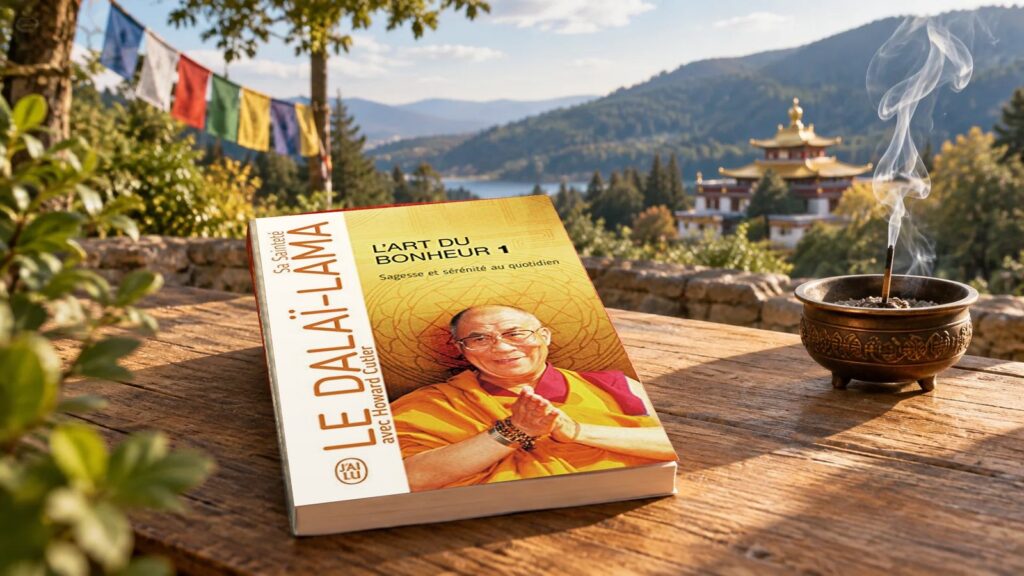
Among the books that have allowed a wide readership to approach Buddhist thought through simple, accessible language, The Art of Happiness holds a particular place. Born of a dialogue between the Dalai Lama and Howard Cutler, it does not present itself as an abstract treatise. It speaks to concrete life: our relationships, our worries, our fears, our expectations, the way we inhabit daily life.
Looking for happiness in the wrong direction
Its starting point is at once simple and profound: everyone seeks happiness, yet often looks for it in directions that bring the mind no lasting ease. We hope to find a form of stability through outer circumstances, through success, recognition or accumulation. Those conditions, however, are forever changing. The book invites us to shift our gaze: what if happiness depended less on what we own than on the way we train the mind?
This is surely one of the book’s strengths: showing that happiness is not merely a passing emotion but an inner orientation that can be cultivated. The view aligns deeply with the Buddhist tradition, which holds that the mind can be trained, clarified, made supple. Where we sometimes believe ourselves condemned to our habits, the book opens another possibility: learning to see differently, to respond differently, to live differently.
An ancient wisdom in ordinary life
As the pages turn, several essential themes emerge clearly: compassion, patience, responsibility towards others, working with difficult emotions, our relationship to suffering. The tone stays direct, human, almost familiar. It does not set out to impress, but to bring an ancient wisdom alive in the contemporary world. For many, that is what makes it a valuable way in.
One striking feature of The Art of Happiness is the way it refuses to set spiritual depth against ordinary reality. The point is not to withdraw from the world, but to inhabit life as it is more rightly. Inner work is not presented as an escape, but as a way of becoming more clear-sighted, steadier, more available. Happiness appears here not as a naive promise, but as the fruit of a gentle and constant discipline.
Who this book can reach
This book can reach very different readers. Some will find in it a first approach to Buddhism, with no technical vocabulary and no overly specialised framework. Others will recognise principles already met in meditation, or in a search for inner transformation. All may receive something valuable: an invitation to slow down, to observe the mind, to discern what truly nourishes a good life.
A natural place at Lerab Ling
At Lerab Ling, this book finds a natural place among those that accompany a path of discovery. It links reflection and experience, spiritual vision and concrete existence. It also reminds us that wisdom is not reserved for a few, but can take shape in the simple gestures of daily life: listening, forgiving, stepping outside oneself, developing a more accurate attention to oneself and to others.
A question that stays with you
To read The Art of Happiness is perhaps to agree to be moved by a quiet but essential question: what, in the end, makes a life more peaceful, more open, more deeply human? Through that question, the book does not only give answers. It opens a space of reflection, of practice and of transformation that can continue long after the reading is done.