

Discovering Buddhism: a clear and living way in
September 17, 2026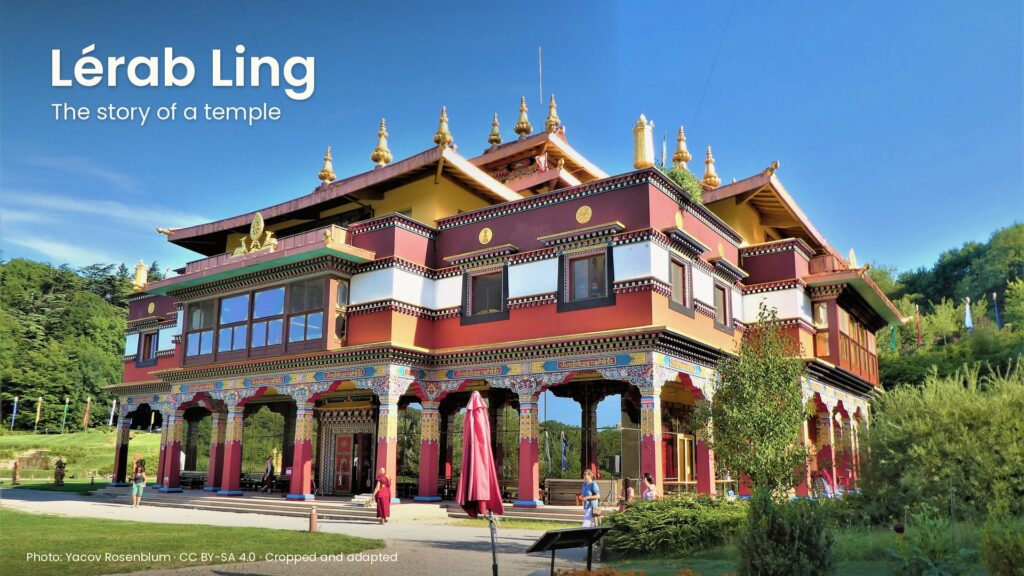
If you have never been, this film is the quickest way to understand the place. It covers the ground: the plateau, the building of the temple, what it holds, and what you will see on arrival.
A centre at 850 metres
Lerab Ling sits on the Escandorgue plateau, 850 metres above sea level. It is a centre for retreat and for the study of Tibetan Buddhism, founded in 1992 by Sogyal Rinpoche.
The site was a dairy farm before that. It was chosen for its quiet and for its beauty. A monastic and lay community lives here all year, and works daily at welcoming the public.
The name itself carries a meaning: Lerab Ling means the place of enlightened activity.
A temple built as a testimony
Building began in 2003 and finished in July 2006. The Dalai Lama came to consecrate the temple in August 2008, eight years after blessing the site during his first visit, in 2000.
The film explains the intention: to build in the West an authentic example of Tibetan spiritual culture, now under threat in its country of origin.
Twenty-one companies worked on the site, most of them from the Hérault and the Aveyron. The decoration was entrusted to artists of Tibetan sacred art, some from Bhutan, others refugees in India and Nepal. They stayed on site for more than a year.
One detail the film picks out: the outer decoration was gilded with gold leaf rather than painted. Out of respect, and because over time it is the less costly method.
The whole project was funded by donations.
The statue and what it holds
At the heart of the temple stands a seven-metre Buddha. It was cast in Burma by a family of craftsmen, using the lost-wax method. It arrived in nine pieces by boat, and was assembled on site.
Its base holds scrolls bearing the words of the Buddha and millions of mantras, the phrases repeated during practice. The Dalai Lama placed three relics there, at the level of the heart.
Two further statues stand on either side. Padmasambhava, the Indian master who brought Buddhism to Tibet in the eighth century. And Avalokiteshvara, the buddha of compassion.
What you will see when you come
The main temple can hold a thousand people. Two further temples and a library occupy the floor above.
Outside, the flags along the road carry printed prayers, which the wind spreads around them. In front of the temple, in the middle of the lake, stands a statue of Padmasambhava. On the lawn, eight statues represent the great bodhisattvas, the figures who embody the commitment to help others.
The place is in use all year. Retreats and regular courses are held for anyone wanting to discover meditation, or simply to pause. Teachers come for weekends or for longer events, and the teachings given are recorded and translated.
One request is made at the end of the film: please do not touch the sacred objects, nor the paintings and decoration of the temple.
Going further
Our page on visiting the centre gives opening days and times. The full programme lists the coming dates for retreats and courses.